
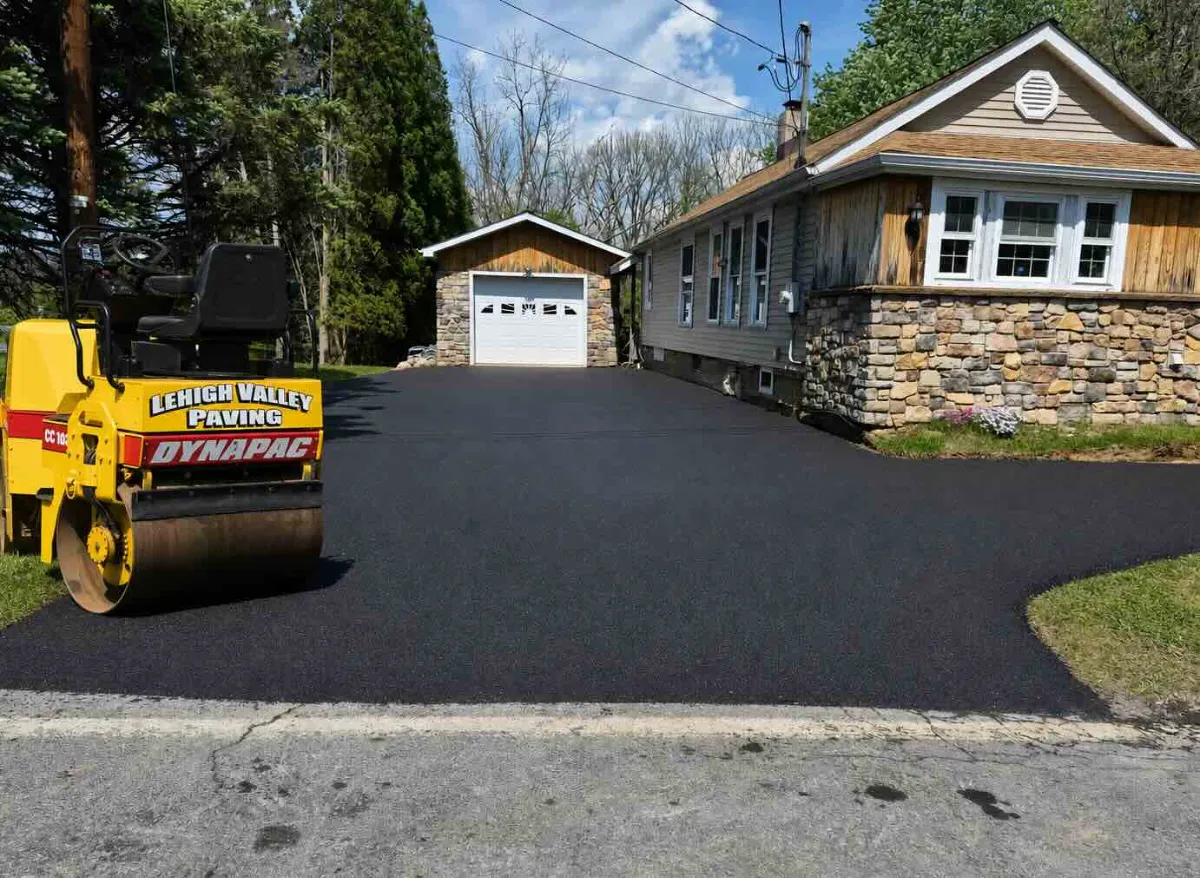
Driveway installation in the Lehigh Valley quietly shapes everyday life around the house. It decides whether you glide into your parking spot or bounce over ruts, whether snow melts cleanly or sits in icy puddles, and whether rain politely moves away from your home or tries to sneak into your garage. When a driveway installation goes right, you stop noticing it and just live with it. When it goes wrong, you notice it every single time you pull in.
Here in the Valley, neighbors talk just as much about “how long the driveway will hold up” as they do about the look of it, and for good reason. Let’s dive deeper into this topic and explore how driveway installation works in our area, what really matters beneath the surface, and how to keep a new driveway feeling solid and dependable for years.
Why driveway installation matters so much here
Driveways in the Lehigh Valley don’t get an easy life. We see hot summers, cold winters, and those sharp freeze–thaw swings that can turn tiny cracks into real problems. A driveway that looks perfectly fine in the fall can come out of winter with heaving, spider cracks, and uneven spots if it wasn’t built on a solid base.
When we talk about good driveway installation here, we’re really talking about four things: how well it handles snow removal, how reliably it drains water, how safe and smooth it feels underfoot and under tires, and how gracefully it ages. Most residential driveway installation in the region leans toward asphalt because it flexes with temperature changes, repairs fairly well, and doesn’t demand a complete restart every time something small goes wrong.
Choosing a driveway material that actually works here
Asphalt driveways
Asphalt is the workhorse of driveway installation around Allentown, Bethlehem, Easton, and the surrounding townships. From our perspective in the Valley, it hits the sweet spot between cost, durability, and practicality. It’s built to handle our winters and doesn’t mind the heat as much as some materials.
Because asphalt can flex, it tolerates the constant expansion and contraction that comes with freeze–thaw cycles. When the base and drainage are done right, an asphalt driveway settles into a long, steady life instead of a short burst of looking good followed by years of patching. The darker surface also absorbs more sunlight in winter, which helps snow and ice loosen up a little faster.
The trade‑offs are straightforward. Asphalt driveway installation depends heavily on a properly built stone base and good compaction. It also benefits from occasional sealing to slow down aging and water damage. If those pieces stay on track, asphalt generally makes sense for most homes in the region.
Concrete driveways
Concrete is more of a style and design choice in our area. You see it in neighborhoods where homeowners want a brighter, lighter look or decorative finishes. Concrete can hold up very well, but it’s less forgiving if the base or drainage isn’t right. In the Lehigh Valley, “less forgiving” usually means it shows its problems more clearly when the ground moves.
From our vantage point, concrete driveways make sense when homeowners are willing to invest a bit more and have a strong reason to prefer the look or finish. It offers a crisp, clean surface and can be stamped or textured. But if the soil moves or water doesn’t drain properly, cracks can show up in ways that are harder to hide than asphalt repairs.
Gravel and stone driveways
Out toward more rural roads and longer properties, gravel remains a practical option. Driveway installation with gravel often prioritizes reach and budget: get from the road to the house in a way that can be managed and refreshed over time.
Gravel driveways handle steep slopes and long runs well, especially when budgets are tight. The trade‑offs come in the form of dust, mud, and ruts, and they ask you to accept ongoing maintenance as part of the deal. From a Lehigh Valley point of view, gravel makes sense when you care more about access and flexibility than about a clean, finished look.
Planning a driveway installation project in the Lehigh Valley
Before anyone fires up a saw or brings in a roller, driveway installation starts as a planning conversation. This is where the job either sets itself up for decades of quiet success or years of annoyance.
Site assessment and layout
We look at driveways in the Valley the same way we look at our hills and streets: by watching where water wants to go and how the ground likes to move. A good site assessment studies slope, drainage, soil conditions, and whatever driveway you already have.
We pay close attention to how water moves during heavy rain. The driveway should encourage water to go out to safe drainage areas, not toward your foundation or into the garage. Clay‑heavy or soft soils often call for a deeper stone base. If there’s an existing driveway, it’s not enough to look at the cracks; we ask why those cracks showed up in the first place.
Layout matters too. We picture the driveway from the moment a car turns off the street all the way up to the garage. How wide should it be? Where does it need to flare out for easier parking? How does it interact with walkways and steps? Driveway installation starts with this mental map long before the first piece of equipment touches the property.
Permits and local rules
Around the Lehigh Valley, every township or borough has its own way of looking at driveways and streets. Sometimes you’re free to make changes without much paperwork, and sometimes you need approval to adjust width, alter drainage, or change the way your driveway meets the road.
We’ve learned that checking these details early is more than a formality. It keeps homeowners away from headaches and makes sure the new driveway installation sits comfortably within local expectations. That way, the driveway doesn’t just work physically; it also fits into how the neighborhood and town want things to look and flow.
How asphalt driveway installation typically works
Once the planning feels solid, asphalt driveway installation in the Lehigh Valley tends to follow a familiar rhythm. The ground and layout might be different from property to property, but the backbone of the process stays the same.
Step 1: Removing the old driveway or prepping bare ground
First, the old surface has to tell its story. When we remove an existing driveway, we get to see what’s going on underneath. Broken asphalt or cracked concrete rarely fail on their own; they usually fail because the base wasn’t ready, the drainage was ignored, or the soil was never really tamed.
On properties without a proper driveway, we strip away topsoil and loose fill to reach firmer ground. We do that because organic material doesn’t stay put. It shifts, settles, and breaks the bond between the surface and the base. Good driveway installation in the Lehigh Valley doesn’t sit on top of uncertainty.
Step 2: Grading and shaping drainage
Once we see what we’re working with, grading begins. This is where we give the driveway its future shape and decide how it will treat water. From the Valley’s perspective, grading is part engineering and part common sense: we don’t want puddles, and we don’t want water creeping toward the house.
We create a gentle slope or crown so water can roll off the surface instead of camping out on it. We smooth transitions near the garage and around walkways so you don’t walk through surprise pools every time it rains. In our climate, grading is just as important as the asphalt itself because water always finds the weak spots.
Step 3: Building the stone base
If you ever want to talk about what really makes or breaks driveway installation around here, talk about the base. This stone layer doesn’t get any attention once the asphalt goes down, but it quietly carries the whole load for years.
We build the base in layers of crushed stone, compacting as we go. The depth depends on your soil and how you use your driveway. A driveway that regularly hosts heavy work trucks or trailers needs more strength than one that only sees a couple of family cars. In the Valley, we’ve watched enough driveways age to know that the ones with a well‑built base usually age gracefully.
The base spreads out the weight of vehicles, resists movement, and gives water somewhere to go. Without that, the driveway is just a decorative cover sitting on top of trouble. With it, the driveway installation has a strong backbone.
Step 4: Preparing and supporting the edges
Edges are quiet troublemakers if we ignore them. Here, where snow plows, blowers, and lawn equipment regularly cross the line between driveway and yard, edges get more abuse than most people realize.
We shape and support edges so they’re not hanging out in midair. This might mean building up soil or stone beside the asphalt to keep tires and equipment from chipping and breaking the sides. It also means making transitions to grass, mulch, or walkways that feel natural, not like sudden steps. When we think about driveway installation in the Valley, we treat edges as part of the structure, not decoration.
Step 5: Asphalt installation and compaction
When the base feels solid and edges are supported, it’s time for the visible part: the asphalt itself. Hot mix arrives, spreads out, and starts turning into the surface you’ll live with for years.
In this stage, we focus on thickness, even coverage, and smooth transitions. The asphalt needs enough depth to handle daily use, and it needs to be placed in a way that avoids weak seams. Rollers compact the mix into a tight, solid layer. We pay extra attention where the driveway meets the road and where it meets the garage because those are high‑traffic stress points.
Step 6: Finishing and initial curing
When the last passes are done and the surface looks ready, the driveway isn’t truly ready yet. It still needs time to settle and harden. In the Lehigh Valley, temperatures can swing, and we respect that by giving fresh asphalt room to breathe and cure.
We mark the area off, ask homeowners to keep vehicles out for a short period, and encourage gentle use once they start driving on it. In the first days, we want tires rolling straight, not grinding in tight circles. Over the weeks and months that follow, the driveway firms up and starts behaving like the long‑term surface it’s meant to be.
What affects driveway installation cost in the Lehigh Valley
From our regional perspective, driveway installation costs don’t come out of a single chart. They come from a mix of realities on each property.
Size and layout are obvious factors. Longer and wider driveways use more stone and asphalt. A straight run that leads directly to a garage is simpler than a curved layout that flares out or includes extra parking pads.
Removal and base work have a big say in the budget. Paving over a failing driveway without addressing the base doesn’t serve anyone for long. When the existing surface tells us the base is weak, rebuilding it is an investment in not having the same failure repeat.
Access and site conditions can help or complicate the work. Steep slopes, tight entrances, and limited space for equipment change how quickly and easily the crew can move. Soft or unpredictable soils call for more careful excavation and stronger base depth.
Materials and labor also shift over time. Fuel costs, asphalt prices, and regional demand all move the needle. In practice, that’s why homeowners rely on project‑specific quotes rather than trying to guess from broad averages.
How long driveway installation usually takes
From a Lehigh Valley vantage point, driveway installation is often less about weeks of disruption and more about catching the right weather window.
A straightforward tear‑out and replacement can often be completed in a couple of days once the crew is scheduled and the conditions cooperate. Projects that include significant grading changes, new drainage solutions, or deep base rebuilding take longer, but they still move in clear stages.
Weather always joins the conversation. Heavy rain or extreme cold can pause asphalt work because the material and equipment need stable conditions. Around here, crews often plan jobs with some flexibility to slide a day or two when the forecast changes.
Living with a new driveway: care in the first year
Once the driveway installation wraps up and the last piece of equipment leaves, the story isn’t over. The first year of living with a new driveway in the Lehigh Valley sets the tone for how it behaves later.
Early use habits
In the early days, we encourage a lighter touch. Instead of parking in exactly the same grooves day after day, it helps to vary where you stop slightly. Turning the steering wheel while the vehicle is still can grind the surface, especially when the asphalt is young and softer.
Heavy vehicles deserve extra caution. Work trucks, trailers, and large equipment add real weight and stress. Letting the driveway cure through that initial period before inviting the heavy loads onto it pays off with fewer ruts and scars.
Sealing and routine maintenance
Sealing is one of those topics that gets tossed around a lot, and from our regional perspective, it’s a helpful tool when used at the right time. Sealcoating doesn’t rescue a failing base or fix deep structural issues, but it does help protect the asphalt from sun, water, and chemical spills.
Once the driveway has cured enough, many homeowners in the Valley add sealing to their long‑term plan. Beyond that, they watch the surface after heavy storms to see how water behaves, clean up oil spots quickly, and keep an eye on edges where equipment and weather might take a toll.
Small cracks and holes are easiest to deal with when they first appear. Addressing them early prevents water and ice from turning them into bigger problems down the road.
Common driveway installation mistakes to avoid
From watching driveways age up and down the Valley, a few patterns stand out.
Skipping serious base preparation and simply paving over questionable ground leads straight to premature failure. Ignoring drainage and allowing standing water to hang around on the surface or near the garage turns the driveway into a sponge for trouble. Parking heavy vehicles on fresh asphalt before it has time to harden invites permanent dents and depressions.
Overlooking local rules about how the driveway meets the road can also cause trouble later. It’s not just about permission; it’s about making sure the driveway doesn’t accidentally create plowing issues, sightline problems, or stormwater headaches.
Curious Driveway Installation Questions, Straight Lehigh Valley Answers
How long does an asphalt driveway typically last here?
When a driveway installation follows good base preparation, sensible drainage, and straightforward maintenance, an asphalt driveway in the Lehigh Valley often serves reliably for a couple of decades before it needs full replacement, though cosmetic wear and minor repairs may show up sooner.
Do I always need to remove my old driveway before new driveway installation?
Not every driveway needs to be torn out. If the current surface is structurally sound and drains well, an overlay may be realistic. If you see major cracks, sinking areas, or obvious water problems, those usually point to deeper issues in the base, and rebuilding from the ground up becomes the more dependable choice.
What’s the best time of year for driveway installation?
From a local standpoint, driveway installation tends to work best in the milder months between spring and fall. Those seasons usually offer the stable temperatures and reasonable moisture levels that asphalt and base materials prefer. Winter conditions and very wet stretches make the work harder and can affect long‑term performance.
How wide should a residential driveway be for everyday use?
A single‑car driveway generally feels comfortable when you can open doors fully and move around the vehicle without stepping off the surface. Two‑car driveways are sized so both vehicles can sit side by side without constantly touching the edges. Local rules near the street often add minimums or limits, so it makes sense to check those while planning.
What’s the most important factor for long‑term driveway performance?
Seen through the Lehigh Valley lens, the heart of long‑term performance is a strong, well‑compacted stone base paired with thoughtful drainage. When those two pieces are right, the visible surface has a chance to age gracefully. When they’re ignored, even the best asphalt or concrete may struggle with our freeze–thaw cycles and rain patterns.