
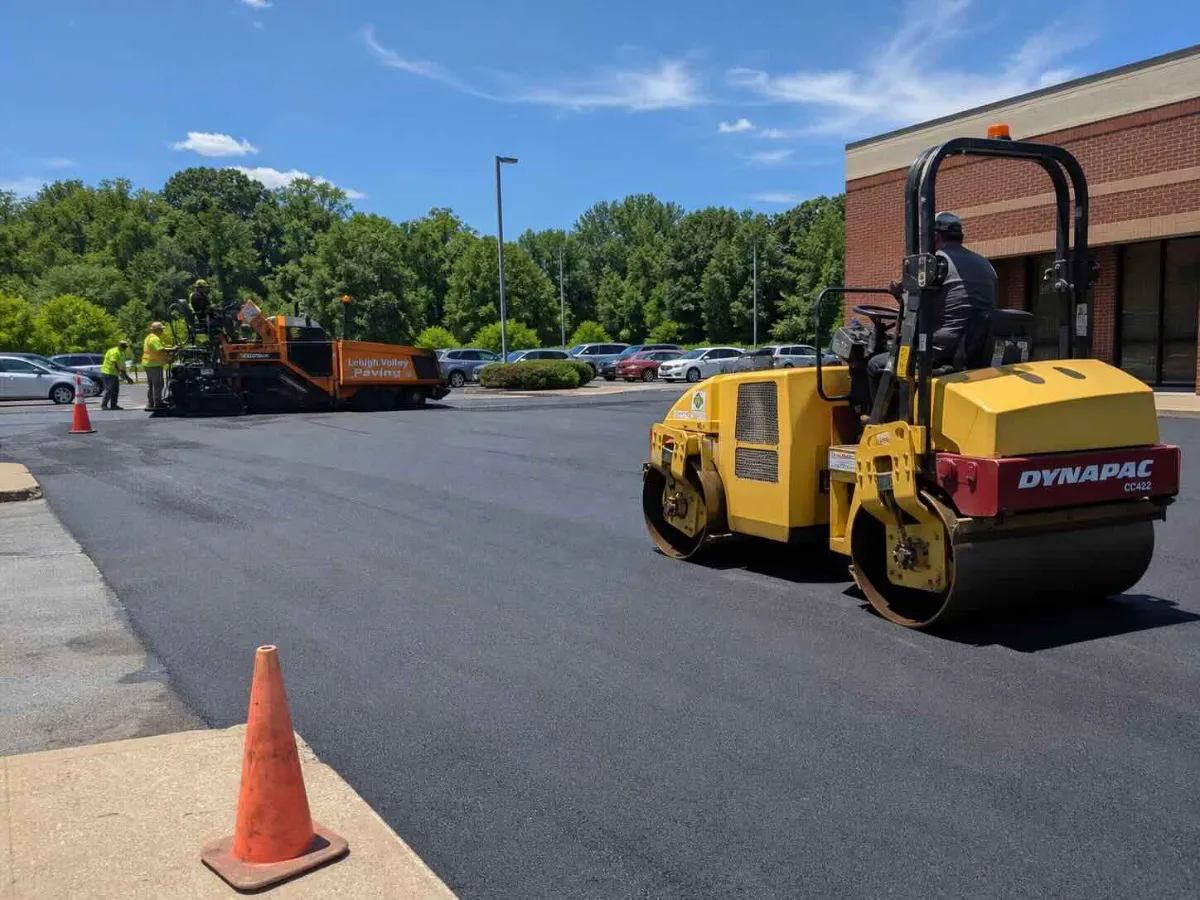
A well-planned parking lot does much more than give people a place to park; parking lot paving services quietly keep traffic moving, protect vehicles, and stand up to weather and heavy use for years. When property owners start looking into these services, they’re usually trying to answer a simple question: what does it take to end up with a lot that actually lasts, instead of one that starts cracking and raveling long before it should?
In this guide, we’ll dive deep into what we see and do in the field every day—how we look at a site, how we decide whether to repair or replace, and what it takes to build a parking lot that holds up under real-world conditions.
Why Parking Lot Quality Matters
A parking lot is one of the most heavily used parts of any commercial property. Every day, it handles constant vehicle movement, turning, stopping, and sometimes heavy truck traffic in small areas like loading zones or drive-thrus. When the pavement is designed, installed, and maintained properly, it quietly does its job for years with only modest routine care.
When parking lot paving services miss the mark, problems show up fast. Cracks let water into the base. Standing water collects near entrances and walkways. Potholes appear in turning areas and drive aisles. Striping slowly fades until drivers are guessing where to park and where to drive. Over time, these issues chip away at safety, curb appeal, and even liability.
Good decisions at the beginning are what prevent those headaches later. That’s why we spend time up front evaluating the site, traffic loads, and drainage before recommending any specific type of work. The goal is simple: a parking lot that looks good, works well, and keeps doing its job long after the paving crew leaves.
When Do You Need Parking Lot Paving Services?
Most property owners reach out when something looks wrong—cracks, potholes, or puddles that have become hard to ignore. But cosmetic damage isn’t the only signal. Pavement can be structurally tired even before the lot looks “bad,” and waiting until failure is obvious usually makes solutions more expensive.
Common Signs It’s Time to Act
A few patterns tend to show that parking lot paving services should be on your radar. Widespread cracking, especially interconnected “alligator” cracking, suggests deeper fatigue in the asphalt structure rather than simple surface wear. Recurring potholes in the same areas, even after patching, tell you the support below is compromised. Visible rutting, wheel paths, low spots, or “waves” where vehicles stop or turn often point back to base or subgrade problems. Chronic standing water after rain, especially along entrances, walkways, and drive aisles, hints at drainage or grading issues that will only accelerate damage.
We also consider age. Asphalt parking lots have an expected service life, and once a lot approaches that point, repairs alone may not make economic sense. Heavy surface wear, raveling, and large areas of patchwork usually mean the pavement is near the end of its life, even if parts of the base can still be salvaged.
Repair, Resurface, or Replace?
One of the most important calls is whether to repair, resurface, or completely reconstruct. The right choice depends on the pavement’s age and overall condition, the strength and stability of the base, and how well the lot manages water.
Repairs make sense when most of the lot is still structurally sound, but you’re seeing localized failures—isolated potholes, cracks in certain sections, or damage from specific loading areas. Resurfacing or overlay becomes the better option when wear is widespread but the underlying base is still stable, allowing a new asphalt layer to reinforce the structure without starting from scratch. Full replacement comes into play when the base has failed, when there’s severe movement or settlement, or when deep structural issues are spread across the lot. In those situations, rebuilding from the base up is usually the only way to reset the pavement’s life cycle.
Parking lot paving services aren’t a simple yes-or-no to “new asphalt.” They’re a set of options, and the key is matching the solution to what’s really happening under those tires.
How We Evaluate Existing Parking Lots
Before any paving plan takes shape, the first step is a thorough assessment. This isn’t a quick loop around the property. It’s a systematic look at what’s happening both on the surface and beneath it, guided by experience with local soils, weather, and traffic.
Surface Condition and Traffic Patterns
We start with the pavement itself. Different crack types—longitudinal, transverse, block, and alligator—tell us different things about stress and movement. Existing patches show how previous repairs have held up and whether they were done in a way that supports long-term performance. Turning and braking areas, stop lines, and entrances often show wear earlier than static parking rows, so they get extra attention. Edges and transitions to concrete, utility structures, and sidewalks reveal how the pavement is interacting with other materials.
At the same time, we watch how vehicles actually use the lot. Main drive aisles carry the bulk of daily traffic. Delivery trucks and garbage trucks follow predictable paths and turning radii that can create unique wear patterns. Loading areas and drive-thru lanes may see heavy, repetitive traffic in tight spaces. Pedestrian routes from parking spaces to entrances show where people need the safest, most comfortable surface. Parking lot paving services that ignore these patterns tend to produce lots that look fine at first but wear unevenly and fail early in high-stress zones.
Base Condition and Drainage
You can’t see the base without coring or excavation, but its condition shows through the pavement. Wide, uneven settlement indicates subgrade or base problems. Potholes that return after patching suggest that the support below the asphalt is not adequate. Certain cracking patterns and rutting point to thin base or poor compaction.
Drainage is just as important as structure. Standing water is more than an annoyance—it’s a slow, steady way to shorten pavement life. Water that sits on the surface finds its way into joints and cracks, weakens the base, and invites freeze–thaw damage when temperatures drop. During an evaluation, we look for low spots and “birdbaths” where water lingers, follow the paths water takes toward inlets or landscaped areas, and note any places where water crosses pedestrian routes or collects near entrances. Signs of erosion at curbs or catch basins tell us how the lot has been handling storms up to now.
Parking lot paving services that tackle drainage early—through grading changes, inlet adjustments, or slope corrections—give every other part of the job a better chance to succeed.
New Parking Lot Construction: Step-by-Step
When a site needs a completely new parking lot, the process starts long before a paver rolls onto the property. A durable lot is built from the ground up, and every phase has to pull its weight.
Subgrade Preparation
The subgrade is the native soil or fill under the base. If it’s soft, poorly compacted, or prone to trapping water, no amount of quality asphalt on top will fix it. That’s why we focus first on what’s underneath.
We remove unsuitable materials and replace them with fill that can be compacted properly. We work toward uniform compaction across the entire footprint, not just the spots that are easiest to reach. We shape the subgrade to the slopes that will eventually carry water off the surface and toward proper drainage structures. When this step is rushed or skipped, settlement, depressions, and cracking show up a few years after paving, and the lot never quite behaves the way it should.
Parking lot paving services that treat subgrade preparation as the foundation it is tend to produce lots that feel solid, drain properly, and stand up to daily use.
Aggregate Base and Thickness
Over that prepared subgrade, an aggregate base provides the structural support that distributes loads. The right thickness depends on the traffic the lot will see.
Lots that primarily serve passenger vehicles can usually rely on thinner base sections. Mixed-use sites with delivery trucks or occasional heavier vehicles need more robust support. Areas that see frequent heavy loads—drive aisles for trucks, loading zones, dumpster pads, and drive-thru lanes—often require thicker base or adjusted structural design. Rules of thumb can help, but in practice, we combine those guidelines with local soil conditions and our experience with similar sites nearby.
Compaction is the line between a base that behaves and a base that settles. Density tests, careful rolling, and attention to moisture levels help lock the aggregate together. Once the base is right, everything else has a fighting chance.
Asphalt Placement and Compaction
With the base ready, asphalt installation can begin. That process typically involves placing asphalt in one or more lifts to build the required thickness, keeping the material in the right temperature range for proper workability and compaction, and rolling the surface to achieve uniform density and smooth transitions.
Joints between paving lanes are always watched closely. Poorly treated joints become natural crack lines later. When we overlap and roll adjacent lanes while asphalt is still hot, those joints knit together and resist separation. It’s a quiet detail, but over the life of the lot it matters a lot.
This is where experience with parking lot paving services shows up in subtle ways—the way a crew handles transitions, manages compaction, and deals with changing temperatures over the course of a day.
Striping, Marking, and ADA Layout
Once the pavement has cured, the lot needs markings that make sense on the ground, not just on a plan. That includes standard parking stalls and aisles sized to local code, properly placed accessible spaces with correct signage and access aisles, fire lanes and loading zones, and directional arrows, stop bars, and crosswalks.
We’re not just chasing compliance. We’re looking at how drivers and pedestrians will actually move. Clear, intuitive striping reduces confusion during busy times of day. Crosswalks and paths guide people along safe routes. When parking lot paving services integrate layout with the way the site is used, the lot feels natural to navigate instead of confusing or cramped.
Resurfacing and Overlays: Extending Lot Life
Not every tired parking lot needs to be torn out and rebuilt. Sometimes the base is sound and the issues live mostly in the upper asphalt layers. In those cases, resurfacing or overlay can be the most efficient way to extend the life of the pavement.
When Resurfacing Works Well
Resurfacing is a good fit when most cracking is in the surface layer rather than down in the base, when drainage problems can be addressed with grading and local adjustments, and when the owner wants to extend the life of the lot without the disruption and cost of full reconstruction.
The process often starts with milling or partial removal of existing asphalt where elevations, transitions, or surface defects need to be managed. We repair localized failures, shore up weak areas, and adjust transitions at entrances, sidewalks, and drains. Then we install a new asphalt surface layer over the prepared structure.
Resurfacing adds strength, smooths out old patches and imperfections, and creates an even surface. When we time it right and pair it with drainage improvements and crack repair, it can add many years of service to a lot that otherwise might seem ready to give up.
Targeted Repairs and Maintenance
Not every problem demands a major project. Smart, targeted maintenance often prevents small issues from turning into large ones, and can delay the need for more intensive parking lot paving services.
Crack Filling and Patch Work
Cracks are inevitable as asphalt ages. They don’t look dramatic at first, but they’re direct openings for water. If they stay open, water reaches the base, weakens support, and eventually leads to bigger failures.
We address cracks while they’re still manageable, sealing them to keep water out. When small areas fail, we don’t just coat the surface; we cut out the damaged asphalt, trace the problem down to a stable layer, and rebuild that section so it doesn’t immediately fail again. When potholes keep appearing in the same places, we treat that as a signal to look deeper instead of just putting a patch over the symptom.
Targeted repairs don’t magically restore very old or structurally compromised lots, but they’re an essential part of keeping otherwise sound pavement from sliding down the path toward major reconstruction.
Sealcoating and Surface Protection
Over time, sunlight, water, and spills take a toll on asphalt. Sealcoating is a way to give the surface some protection. When it’s done as part of a thoughtful maintenance plan, it can extend the pavement’s life and help keep it looking and performing more consistently.
The steps are simple but important. The pavement needs to be cleaned thoroughly so the sealer can bond. Cracks should be filled beforehand, because sealer alone won’t fix them. The material should be applied at the right rate and in suitable weather. Then the surface needs enough curing time before normal traffic returns.
Sealcoating is not a cure for deep structural problems, but as part of a routine that includes crack repair and inspections, it helps shield the asphalt from everyday abuse.
Drainage and Grading: The Quiet Work That Protects Your Lot
Water is one of pavement’s biggest enemies. If it can’t leave the surface quickly, it slowly works its way into places where it doesn’t belong. That’s why drainage and grading sit at the heart of successful parking lot paving services, even if they don’t always get the spotlight.
Evaluating and Improving Drainage
When we look at drainage, we’re doing more than counting puddles. We watch how water moves from high points to low points. We see how it flows around landscaped islands, curbs, and building corners. We note where it crosses routes that people use on foot. We tie those observations back to areas of cracking or failure.
Sometimes the fix is straightforward: adjust grades during resurfacing so water flows toward inlets rather than pooling in drive aisles; raise or lower inlets to match the new pavement surface; add drainage structures in areas that have historically held water; or rebuild base in chronically wet spots so the support is consistent instead of soft.
These aren’t flashy changes, but they often determine whether a new or repaired lot reaches its full potential or starts to decline sooner than it should.
Safety, Accessibility, and Compliance
Parking lots do more than support vehicles. They set the stage for how people arrive at and move through a property. That means safety and accessibility are just as much a part of parking lot paving services as asphalt thickness and compaction.
ADA Compliance and Accessible Routes
Accessible parking spaces and routes come with specific requirements for layout, markings, slopes, and signage. When we rework or build a lot, we factor in the number and placement of accessible stalls, the dimensions of access aisles, and the slopes along the routes people will travel from their vehicles to the entrance.
Our aim is to meet those requirements while also making them feel natural for the people who use the site every day. When accessible routes are direct, smooth, and clearly marked, they don’t feel like an afterthought—they feel like part of the main circulation.
Line Striping, Visibility, and Flow
Striping and markings are small details with outsized impact. Clear stall lines reduce small collisions and door dings. Directional arrows cut down on confusion, especially when traffic is busiest. Well-marked crosswalks highlight pedestrian zones and encourage drivers to slow and watch.
When we plan striping as part of parking lot paving services, we look for patterns that match the way the property operates, support emergency and delivery access, and satisfy local regulations. The result is a lot that feels organized, where people aren’t guessing about where to go or worrying about unexpected movements.
How We Plan Work Around Your Operations
Most commercial properties can’t shut down completely while parking lot paving services happen. There are customers, patients, employees, deliveries, and emergency routes to think about. That’s where phasing and planning come into play.
Phasing and Access Management
On busy sites, we often divide the project into sections so part of the lot stays open while another part is under construction. That might look like paving one half of the lot while traffic uses the other half, or tackling drive aisles in stages while leaving some parking rows available.
We try to schedule heavy work during off-peak times or weekends when possible. We plan clear access to main entrances and critical routes. Temporary cones, signage, and barricades help guide drivers so they can still move around safely while the work is underway. The idea is to let the paving happen without shutting down day-to-day operations.
Communication and Onsite Adjustments
Even with a detailed plan, things can change once work starts. Hidden base issues, unforeseen drainage problems, or weather shifts may require adjustments. When that happens, talking through the options and impacts keeps the project on track.
We explain why certain changes need to happen, how they’ll affect access or timing, and what they mean for the finished product. When everyone understands the sequence and the reasoning, parking lot paving services feel less like a disruption and more like a necessary step toward a better lot.
Long-Term Care: Keeping Your Lot Performing
Once the paving crew leaves, the parking lot’s life really begins. From that point on, regular attention and small interventions help determine whether it cruises through its service life or starts demanding major work ahead of schedule.
Regular Inspections
Walking the lot a few times a year is simple but useful. You can spot new cracks developing, especially near joints and edges. You can see where water is lingering in places it didn’t before. You can notice early wear in drive aisles, loading zones, and entrances.
Those observations help you decide when it’s time to bring in crack filling, patching, or a professional evaluation. Parking lot paving services get you to a solid starting point. Inspections help keep you from drifting too far away from it.
Maintenance Intervals
Maintenance schedules vary depending on climate, traffic, and use, but they usually follow the same ideas. Treat cracks when they show up, not years later. Plan for sealcoating at reasonable intervals, based on how your pavement actually behaves and weathers. Handle localized patching when small failures appear, rather than waiting for them to spread.
Owners who treat their pavement like a long-term asset—something that gets routine care, not just occasional crisis attention—rarely wake up to sudden, massive paving bills. Instead, they work through manageable projects that align with their property’s long-range needs.
Choosing the Right Approach for Your Lot
Every site has its own story. Two lots might look equally worn to the casual eye, but one may be a solid candidate for resurfacing while the other needs reconstruction from the base up.
When we walk a site to discuss parking lot paving services, we’re trying to answer a few core questions. What is the lot’s current structural condition? How do vehicles and people use the space throughout a typical day? Where does water go when it rains, and where does it stay too long? What are the realistic budget constraints and long-term plans for the property?
The answers steer the solution. Sometimes it makes sense to fix drainage and patch failures now, then resurface when the timing and budget line up. Other times, the base has failed so thoroughly that starting over is the only way to avoid chasing problems year after year.
Underneath all of that is experience: with local materials, with regional weather patterns, with how certain designs have held up on similar sites. That’s how parking lot paving services move from being a generic concept to a tailored approach that gives each lot its best chance to perform well over time.
Questions We Hear All the Time about Parking Lot Paving Services
How do I know if my parking lot needs resurfacing or full replacement?
It comes down to whether the problems are mostly in the surface or in the underlying structure. If wear and cracking are largely in the top layers and the lot isn’t showing deep settlement or repeated failures, resurfacing or overlay often makes sense. If the base is failing, the pavement is moving, or potholes keep coming back after repairs, full replacement with base reconstruction is usually the more durable path.
How long will a new asphalt parking lot last?
Service life depends on design, traffic, climate, drainage, and maintenance. A well-built asphalt parking lot with proper base support, good slopes, and routine care can perform for many years before it needs major work. Lots with heavy truck traffic or chronic standing water may require earlier repairs or resurfacing to stay in good condition.
What can I do to extend the life of my existing parking lot?
Consistent, simple maintenance goes a long way. Treat cracks promptly so water doesn’t reach the base. Use sealcoating to help protect the asphalt from sunlight and spills. Pay attention to drainage and correct problems when you see them. Regular inspections and timely repairs to small failures help slow overall deterioration and delay the need for large-scale parking lot paving services.
How does drainage affect the performance of my parking lot?
Drainage directly affects pavement health. Water that stays on the surface finds its way into joints and cracks, weakens the base, and contributes to freeze–thaw damage and potholes. When grading, inlets, and slopes are designed and maintained properly, water moves off the pavement quickly and the asphalt has a better chance of reaching its intended lifespan.
What should I expect during a parking lot paving project?
You can expect an initial evaluation of the lot, a clear plan for base work or repairs, asphalt placement and compaction, and, when appropriate, striping and follow-up maintenance like sealcoating. On active commercial sites, work is usually phased so parts of the lot remain open and access stays safe. Good communication about closures, curing times, and traffic routing helps your operations continue while the paving work moves forward.