
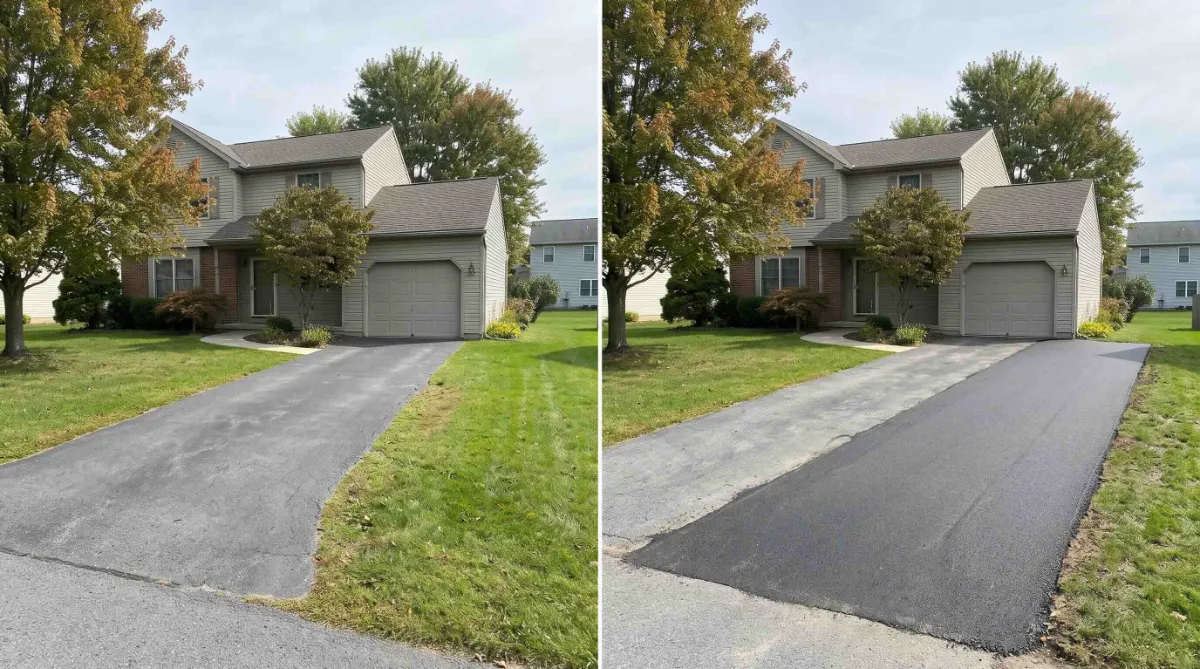
When parking another car means leaving two tires in the grass, asphalt driveway widening starts to sound like a practical fix. Yes, you can widen an existing asphalt driveway without replacing the whole thing, as long as the pavement is stable and there’s enough suitable space beside it. The work involves more than laying asphalt over the lawn, though—you need a properly prepared base, a solid connection to the existing driveway, and a plan for where rainwater will go.
Maybe your household has another driver now. Maybe you’re tired of stepping into wet grass when you open the car door. Or perhaps your pickup fits on the pavement but barely leaves room for anyone to walk past it.
Whatever brought you here, the goal is more usable space—not simply more blacktop. A successful asphalt driveway widening project should make parking easier while keeping water away from your garage, protecting the pavement edges, and fitting your property’s restrictions.
Here’s what we consider when helping Lehigh Valley homeowners decide whether widening makes sense.
Is Your Driveway a Good Candidate for Widening?
A lawn beside the driveway can look like an easy place for another parking space. Sometimes it is. Other times, the existing pavement or the ground beneath that lawn changes the scope considerably.
Start With the Existing Pavement
The best candidate has a reasonably stable driveway with an edge that can support a clean connection. Fading and a few isolated cracks don’t automatically rule out an addition. Widespread sinking, deep cracking, crumbling edges, or recurring potholes deserve closer attention.
We need to understand why those problems developed before connecting new pavement to them.
For asphalt driveway widening, the distinction matters: surface wear may allow a straightforward addition, while base failure can require rebuilding part of the original driveway first. Otherwise, the new section meets pavement that’s still moving or breaking apart.
Walk the driveway after rain, too. A dry surface can hide depressions that become obvious once water collects.
Make Sure the Space Will Actually Work
Think about how you’ll use the added area. Extra room for opening doors requires a different layout than side-by-side parking or space for a trailer.
Mark the proposed boundaries and park your vehicles nearby. Check walking clearance, backing movements, garage access, and the distance from steps or landscaping. A wider parking area won’t solve a tight turning movement if the approach remains awkward.
The most useful asphalt driveway widening layout may add space near the garage rather than along the full driveway. That can preserve lawn and reduce excavation while addressing the actual problem.
Also consider snow storage. A parking space loses some usefulness if plowed snow occupies it every winter.
Confirm Property Lines and Water Flow
Don’t treat a fence, hedge, or mowing line as a verified property boundary. Review your survey, and arrange professional boundary verification when necessary. Easements can also restrict improvements even where you own the land.
Drainage needs equal attention. Replacing grass with asphalt changes how rainfall moves across the property. Water that once soaked into the lawn needs another route.
In the Lehigh Valley, rain, snowmelt, and freezing temperatures make that route important. Asphalt driveway widening should not create a low pocket beside the garage or push runoff toward a neighboring property. Existing driveway drainage problems need to become part of the plan, not something left for later.
What to Check Before Widening Your Driveway
Before scheduling excavation, confirm what you’re allowed to build. Requirements vary across Lehigh Valley municipalities, and the rules for your address may differ from those a friend encountered a few miles away.
Local Approvals, Setbacks, and Impervious Coverage
Start with your municipal zoning or permit office. Describe the proposed dimensions, location, and whether the project changes the driveway entrance.
Ask about:
- Required zoning, driveway, or construction approvals.
- Minimum distances from property lines.
- Limits on driveway width or front-yard parking.
- Maximum impervious coverage.
- Stormwater review or drainage documentation.
- Restrictions involving easements or rights-of-way.
Asphalt driveway widening adds impervious surface, meaning ground that no longer readily absorbs rainfall. Your municipality may evaluate that additional coverage alongside the house, patios, sidewalks, and other paved areas.
Don’t assume a modest addition avoids review. Ask which requirements apply to your specific lot, and get clarification before finalizing the layout.
A contractor can help explain the proposed construction, but an estimate isn’t the same thing as municipal approval.
Underground Utilities and Private Lines
Excavation requires utility coordination. The project should follow Pennsylvania’s utility-notification requirements through Pennsylvania One Call before digging begins.
Public utility markings don’t necessarily identify every buried feature on a residential property. Private electrical lines, irrigation pipes, landscape lighting, drainage connections, and lines serving detached buildings may require separate locating.
Before asphalt driveway widening begins, point out anything you know runs through the work area. Old photographs, installation records, and information from previous owners can help identify questions worth investigating.
This is also the time to discuss septic components, wells, and drainage infrastructure near the proposed pavement. Finding a conflict while planning is much better than finding it with an excavator.
Driveway Entrance and Roadway Restrictions
Adding a parking bay near the house differs from widening the driveway where it meets the street.
Entrance changes can involve curb openings, sidewalks, roadside swales, culverts, sight distance, and public rights-of-way. A wider driveway doesn’t automatically mean you can widen the street connection by the same amount.
If your property connects to a state-owned road, check with PennDOT about Highway Occupancy Permit requirements. Altering a driveway within the state highway right-of-way requires approval; ordinary maintenance is a different category.
For asphalt driveway widening along a municipal street, confirm the local road authority’s requirements. Keep sidewalks, drainage paths, and visibility in the discussion from the beginning.
How Asphalt Driveway Widening Works
The finished asphalt gets most of the attention. The excavation, stone, and grading underneath it determine whether that new parking space stays useful.
Establish the Layout and Finished Elevations
First, we establish where the addition starts, how wide it becomes, and how it connects to the driveway you’re keeping.
Measurements need to account for garage floors, walkways, steps, landscaping, and the road entrance. We also consider where vehicles will turn and where tires will sit during regular parking.
A practical asphalt driveway widening plan starts with those relationships rather than a square-footage target alone. Adding pavement too close to a step can create an awkward transition. Raising the surface without checking elevations can send water somewhere it shouldn’t go.
The layout should show both the parking space and the drainage path.
Excavate Beyond the Grass and Topsoil
The crew removes grass, topsoil, roots, and other unsuitable material from the addition area. Asphalt needs structural support; lawn soil isn’t a substitute for a pavement base.
Excavation continues to the depth required for the planned stone and asphalt sections. If the crew encounters soft ground, buried debris, or unstable fill, those conditions may require additional removal and replacement.
During asphalt driveway widening, this is where an apparently simple strip of lawn can reveal extra work. That doesn’t mean every project needs extensive excavation. It means the ground—not just the surface dimensions—helps determine the construction.
Nearby trees also deserve care. Cutting significant roots can affect tree health and stability, so some layouts need adjustment or input from an arborist.
Build and Compact the Stone Base
Once the exposed ground is suitable, the crew installs the aggregate base and compacts it in controlled layers.
The base spreads vehicle loads and supports the asphalt above it. Its required depth depends on soil conditions, expected traffic, drainage, and the project specifications. A parking area for passenger cars may need a different design than one supporting a frequently parked RV.
For asphalt driveway widening, the new base also needs careful preparation beside the old driveway. Loose material or poor compaction along that boundary can contribute to settlement and an uneven joint.
Our approach to driveway installation starts below the pavement because a smooth surface can’t compensate for weak support.
Grade the Addition for Drainage
Grading establishes how water leaves the finished driveway. The new section must work with the existing surface, not simply match its height at one edge.
Depending on the property, the work may involve adjusting surrounding soil, correcting a low area, or incorporating an appropriate drainage system. A drain needs a suitable discharge point; collecting water without planning where it goes doesn’t solve the problem.
Across the Lehigh Valley, freeze-thaw conditions make trapped moisture especially unwelcome. Water can weaken support beneath the pavement and contribute to movement as temperatures change.
Good asphalt driveway widening accounts for runoff from nearby roofs, lawns, and slopes as well as rain falling directly on the new pavement.
Prepare the Joint and Install Asphalt
The crew typically cuts back deteriorated or irregular pavement to create a sound connection. The existing edge must be clean and properly prepared, with bonding material used as appropriate for the joint and installation method.
Then the crew places and compacts the asphalt to the specified finished thickness. That distinction matters: loose asphalt becomes thinner during compaction, so estimates should clearly describe the finished pavement section.
A narrow addition can limit equipment access, making installation and compaction planning important. The crew also needs to support the outside edge rather than leave it hanging above an unfinished shoulder.
With asphalt driveway widening, the connection deserves particular attention because the old and new sections were built at different times. Careful preparation reduces avoidable weaknesses, but it doesn’t make the joint disappear.
Before you park on the addition, follow the contractor’s instructions. Weather, pavement temperature, mix characteristics, and vehicle loads affect when the surface is ready.
Will the New Asphalt Match the Existing Driveway?
Not exactly—especially at first. New asphalt usually looks darker than pavement that has weathered through years of sun, traffic, and winter conditions.
Expect a Visible Seam and Color Difference
An addition creates a joint where new asphalt meets old asphalt. You may notice differences in color, aggregate texture, and surface wear on either side.
That contrast alone doesn’t mean anything is wrong. The more important questions are whether the connection is properly constructed, the elevations work, and water drains without collecting along the seam.
For asphalt driveway widening, we recommend setting appearance expectations before construction. A well-built addition can look like an addition, particularly beside an older gray driveway.
Weathering may soften the contrast over time, but it won’t reliably make both sections identical. Sealcoating, when appropriate after the new asphalt has sufficiently cured, may create a more consistent color. It won’t erase texture differences or repair an unstable joint.
When Resurfacing the Entire Driveway Makes Sense
If the existing driveway has a sound base but widespread surface wear, resurfacing the original pavement along with the addition may produce a more consistent finished surface.
That decision requires an elevation check. Another asphalt layer can affect garage clearance, sidewalk transitions, drainage, and the driveway entrance. Some areas may need milling or other preparation rather than simply adding height.
Combining resurfacing with asphalt driveway widening can make sense when you already need surface rehabilitation. It makes less sense to cover failing pavement just to hide the color difference.
Deep settlement, extensive structural cracking, and recurring base problems may call for reconstruction instead. We separate appearance concerns from structural concerns so the finished driveway doesn’t look refreshed while the same underlying problems continue.
What Affects the Cost?
There isn’t one dependable price for widening every driveway. Two additions with similar dimensions can involve very different amounts of excavation, equipment time, and drainage work.
Added Square Footage and Layout
The amount of new pavement affects material quantities and labor. But shape matters, too.
A broad, accessible parking pad may be easier to build than a long, narrow strip squeezed between landscaping and an existing driveway. Curves, tight transitions, and work around steps can add detail without adding much square footage.
When comparing asphalt driveway widening estimates, make sure each contractor is pricing the same dimensions and scope. A lower number may reflect less base preparation, a different asphalt thickness, or excluded restoration work.
Ask for the proposed stone depth, compacted asphalt thickness, joint preparation, and handling of unsuitable soil. Those details tell you more than a single price per square foot.
Site Access, Excavation, and Base Work
Equipment needs a practical route to the work area. Fences, retaining walls, steep grades, overhead branches, and limited space can affect how materials move and which machines the crew can use.
Disposal matters as well. Removing a shallow layer of topsoil differs from hauling away deep unsuitable fill, roots, broken concrete, or other buried material.
Base requirements also change with intended use. Tell us if the addition will hold a work truck, trailer, camper, or another heavier vehicle. Designing for the actual load is more useful than discovering later that the parking area needed stronger support.
A written estimate should explain how the contractor handles unexpected subsurface conditions and obtains approval for additional work.
Drainage Changes and Related Repairs
Drainage corrections can be a meaningful part of asphalt driveway widening costs. Regrading, drain installation, culvert work, or repairing settled pavement can require work outside the new parking area.
The estimate may also need to account for landscaping restoration, topsoil, seeding, edging, or adjustments around existing hardscape.
Don’t remove necessary drainage work simply to make the paving price smaller. A cheaper addition that traps water can create repair expenses that outlast the initial savings.
Ask what the finished project includes: pavement, edge support, runoff management, cleanup, and restoration. Clear scope makes estimates easier to compare and helps prevent disagreements once construction starts.
More FAQs about Asphalt Driveway Widening
Can You Widen an Asphalt Driveway Without Replacing It?
Yes. If the existing driveway has stable pavement and adequate underlying support, a contractor can build an adjoining section. Damaged edges may need removal, and localized repairs may be necessary before connecting the addition. Widespread base failure can make partial or complete reconstruction the better approach.
How Wide Should a Driveway Addition Be?
The right width depends on whether you need door clearance, side-by-side parking, turning space, or room for a larger vehicle. Measure with your actual vehicles and allow room for people to walk. Property setbacks, drainage needs, and local width restrictions can limit the final layout.
Can You Put Asphalt Directly Over Grass to Widen a Driveway?
No. Grass, roots, topsoil, and unsuitable ground must be removed before installing an appropriate compacted base. Asphalt placed over organic material lacks dependable support. As that material compresses or decomposes, the pavement can settle, crack, and develop uneven areas.
How Long Does Widening an Asphalt Driveway Take?
A straightforward asphalt driveway widening project may involve only a few working days of construction, but excavation, drainage corrections, inspections, and weather can extend the schedule. Permit review happens separately. Vehicle access may remain restricted after paving, so confirm both the construction schedule and the reopening instructions.
Will the Joint Between the Old and New Asphalt Crack?
It can. Old and new pavement may move differently, and the connection remains a potential maintenance point. A sound existing edge, proper base preparation, appropriate bonding, and thorough compaction help reduce problems. Monitor the joint and address openings before water contributes to further deterioration.
Get an Estimate for Driveway Widening in the Lehigh Valley
A little extra pavement can make everyday parking noticeably easier. The right plan starts with the space you need, then works through pavement condition, property restrictions, drainage, and construction details.
We evaluate asphalt driveway widening as part of the whole driveway—not as an isolated strip beside it. That helps us identify whether a straightforward addition, targeted repairs, or a broader improvement makes the most sense.
Contact Lehigh Valley Paving for a free estimate on driveway installation and repair. We’ll review your existing driveway, discuss how you want to use the added space, and explain the work your property needs.